
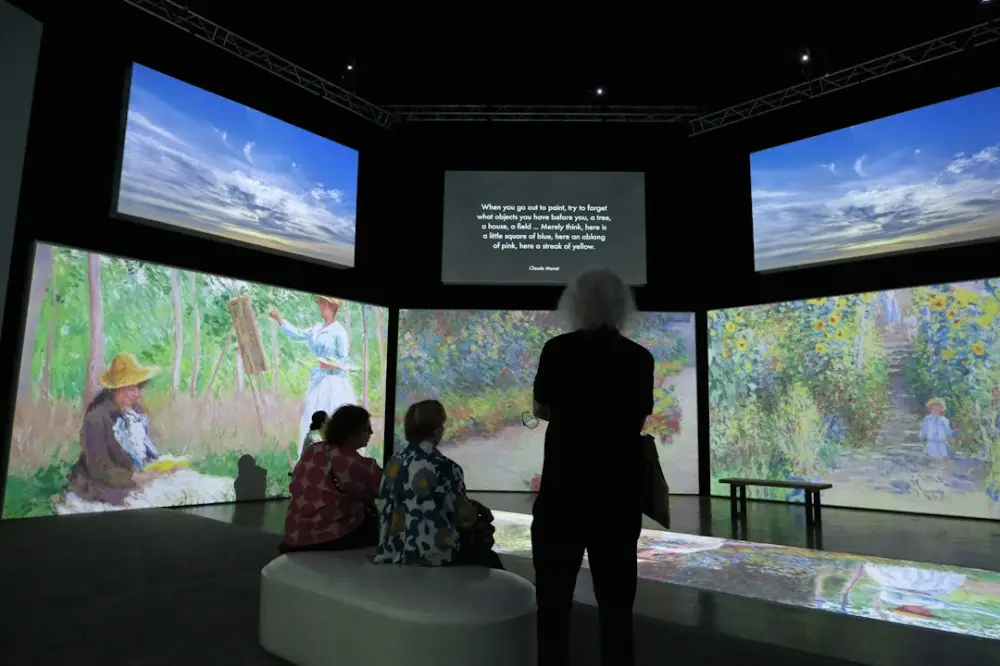
Art beyond conventional display involves presenting creative work outside the standard 'white cube' gallery. It uses site-specific installations, digital elements, and non-linear layouts to remove the physical and psychological distance between the viewer and the object, prioritizing immersive environments and tactile materiality over passive observation from a distance.
Moving away from traditional pedestals and frames allows for a more direct engagement with the work. This shift requires a deep understanding of how architectural features, environmental lighting, and the physical path of the visitor influence the perception of color, scale, and narrative within a creative space.
Defining Art Outside Traditional Gallery Walls
The traditional gallery model relies on a neutral, sterile environment designed to isolate the artwork from the outside world. While this 'white cube' approach focuses attention on the object, it often strips away the context that gives the work its life. Moving art into unconventional spaces—such as decommissioned industrial plants, repurposed residential buildings, or outdoor environments—reintroduces a dialogue between the work and its surroundings.
In these settings, the architecture is not a passive backdrop but an active participant. For instance, an installation in a former textile factory might use the existing hooks and machinery as structural supports for hanging sculptures. This creates a site-specific experience where the history of the building informs the viewer’s understanding of the art. The goal is to move beyond the idea of art as a static commodity and toward art as an environmental experience that changes based on where it is placed and how it is approached.
Techniques for Reimagining the Exhibition Space
To break away from conventional display, curators and designers must rethink the physical journey of the viewer. Instead of a chronological or thematic walk-through along four walls, modern immersive spaces often utilize non-linear arrangements. This might involve placing works in the center of a room, hanging them from the ceiling at varying heights, or embedding them into the floor. Such techniques force the viewer to adjust their posture and perspective, making the act of looking a physical exercise.
Lighting plays a critical role in this transformation. Rather than uniform track lighting, designers might use localized pools of light or colored filters to create distinct 'zones' within a single room. When you set up lighting and layout for an immersive show, the shadows cast by the work become as important as the work itself. Additionally, designing creative spaces that work for both the art and the audience requires balancing the aesthetic impact with functional safety, ensuring that even the most experimental layouts remain accessible and navigable.
Digital integration is another tool for expanding display. Augmented reality (AR) can overlay information or secondary visual layers onto a physical painting, while projection mapping can turn a static sculpture into a moving light display. These tools don't replace the physical object but rather extend its presence into the digital realm, allowing for layers of interaction that a simple frame cannot provide.
Contemporary Artists Pushing Form and Boundary
Several contemporary artists have pioneered methods for challenging the traditional boundaries of the frame and the pedestal. Carl Cheng, for example, has long explored the intersection of nature and technology through his 'Nature Machines.' His work often takes the form of specimens or ecological systems encased in glass or integrated into public infrastructure, forcing viewers to confront the art in the context of their daily environment rather than a secluded room.
Pamela Jorden challenges the convention of the rectangular canvas. By using irregularly shaped stretchers—circles, ovals, and multi-sided polygons—she breaks the 'window' effect of traditional painting. Her work interacts with the wall as a negative space, making the architecture of the room part of the composition. Similarly, Sky Glabush utilizes a wide range of materials, including weaving and ceramics, to bridge the gap between traditional craft and high art. His large-scale works often demand a physical presence that a standard flat painting lacks, inviting the viewer to examine the texture and weight of the materials.
Holly Coulis approaches the problem through the manipulation of perspective and color. While her subjects are often still lifes, her use of vibrant, contrasting outlines creates a sense of depth that feels architectural. By playing with how the eye perceives edges, her work suggests a three-dimensional space that extends beyond the canvas. These artists demonstrate that moving beyond conventional display is not just about where the art is placed, but how the art itself is constructed to defy traditional expectations.
How Materiality and Context Shape the Experience
Materiality refers to the physical qualities of the artwork—its texture, weight, and the way it interacts with light. In a non-conventional display, the materiality of the art must be in conversation with the materiality of the space. A heavy, rusted steel sculpture placed in a glass-walled atrium creates a different tension than the same sculpture placed in a dark, wooden-beamed cellar. The site-specific nature of these installations means that the context provides the 'missing' narrative of the work.
Consider the use of sound as a material. In many immersive environments, soundscapes are used to define the boundaries of a space without physical walls. A low-frequency hum might signal the transition from one 'room' to another in an open-plan warehouse. This sensory layering ensures that the viewer is not just looking at art but is physically submerged within it. Tactile elements, such as allowing viewers to walk on certain surfaces or touch specific materials, further break down the 'do not touch' barrier that has defined gallery culture for centuries.
How unconventional display works in practice
Breaking the white-cube model means linking three mechanics: path, light, and object placement. Curators set a non-linear visitor path, tune localized lighting pools, then place works so architecture and material share the narrative. Digital layers such as AR or projection mapping extend the physical piece without replacing it.
First steps for art beyond conventional display
If you are new to exhibition design, prototype one room before you redesign an entire venue.
- First step: sketch the visitor path and mark where sightlines change.
- Start by testing one localized lighting pool on a single work.
- To begin with layout, remove one pedestal and place a work at eye level in the center.
- Follow these steps to document how each change alters dwell time for one week.
- Next step: add integrated captions instead of freestanding wall labels.
Evolution of Display at Brotkunsthalle
At Brotkunsthalle, the focus remains on how the physical environment can be manipulated to foster a deeper connection between the imagination and the physical world. This requires a departure from the rigid standards of the past. For those designing or managing creative environments, the takeaway is clear: the room is not a container, but a component. To truly move beyond conventional display, one must treat the floor, the ceiling, the light, and the air as tools of the trade.
Practical steps for achieving this include experimenting with varied sightlines and removing the clutter of traditional signage in favor of more integrated information delivery. When the boundaries between the viewer, the artwork, and the room are blurred, the experience becomes memorable and transformative. Brotkunsthalle continues to explore these intersections, emphasizing that the most powerful art experiences are those that allow the mind to wander through a space that feels both curated and undiscovered. By prioritizing the relationship between materiality and layout, we can create environments that do more than just show art—they facilitate a new way of seeing.