
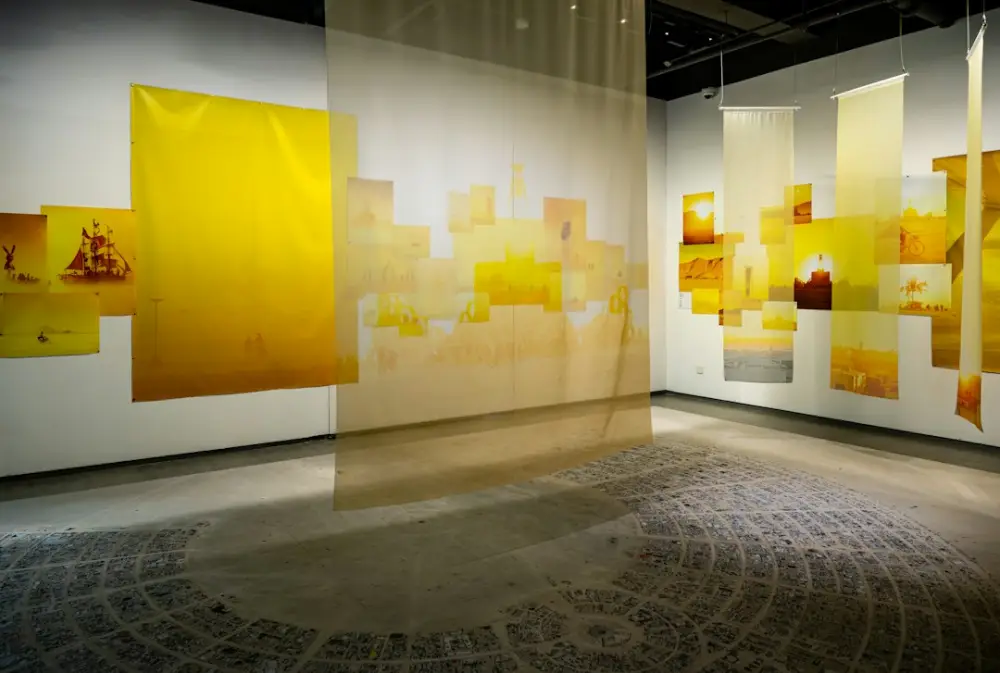
Installation art and spatial perception refers to the practice of creating three-dimensional works that transform a viewer’s awareness of their physical environment. Unlike static objects, these installations use light, sound, and architectural layout to alter the perceived dimensions, scale, and sensory boundaries of a room, making the space itself part of the artwork.
When planning a creative environment, understanding these principles allows designers to guide movement and emotional response. By manipulating floor plans and focal points, you can turn a standard room into an immersive experience that dictates how people interact with their surroundings and each other, rather than just observing from a distance.
What installation art and spatial perception means
At its most practical level, this concept describes the shift from viewing art as a discrete object on a wall to experiencing it as a surrounding environment. In traditional galleries, the "white cube" provides a neutral backdrop designed to disappear. In installation art, the room is the medium. Spatial perception is the mental process by which we identify the distance, size, and orientation of objects around us. When an artist disrupts these cues, they change how we feel within a room.
A classic example is Yayoi Kusama’s Infinity Mirror Rooms. By lining a small room with mirrors and hanging hundreds of small LED lights, the artist eliminates the visual markers of walls and ceilings. The viewer loses their sense of physical boundaries, perceiving the space as an endless void. This transformation relies entirely on manipulating the brain's reliance on visual reflections to determine room size. In these environments, the visitor is not a spectator but a central component of the work’s composition.
Why spatial perception in art matters
The way we perceive space directly influences our psychological state. Narrow, low-ceilinged rooms can induce a sense of intimacy or claustrophobia, while vast, open halls can evoke awe or isolation. For those designing creative spaces that work for both artists and the public, understanding these reactions is vital for creating a specific atmosphere. Spatial art breaks the routine of passive observation, forcing the brain to recalibrate as it moves through an unfamiliar layout.
Consider the conversion of industrial warehouses into contemporary art spaces. The sheer scale of these buildings—often featuring exposed steel beams and massive concrete floors—changes the viewer's relationship to the art. A small painting in a 5,000-square-foot hangar feels different than the same painting in a domestic living room. The architecture informs the art’s perceived importance and weight. By intentionally altering spatial perception, designers can slow down the pace of a visitor’s walk, encourage them to look upward, or create moments of quiet reflection in an otherwise busy environment.
How installation art transforms a room
Transformation occurs through the deliberate use of light, sound, scale, and material. These elements work together to override the existing architectural features of a room. For instance, knowing how to set up lighting and layout for a specific installation can make a solid wall appear translucent or a flat floor feel uneven. Light is perhaps the most powerful tool; it can define paths, hide corners, or create artificial horizons that confuse the eye.
Sound also plays a significant role in spatial perception. Sound artists often use "binaural" recordings or low-frequency vibrations to make a room feel larger or smaller than it is. In a dark room, a sound coming from a far corner can make the space feel cavernous, even if the walls are only a few feet away. Physical materials, such as soft fabric drapes or heavy metal plates, also change the acoustics and the perceived "temperature" of a space. A room filled with felt will feel muffled and compressed, drawing the viewer inward, whereas a room of glass and steel feels expansive and sharp.
Common misconceptions about immersive spaces
A frequent misunderstanding is that installation art requires massive budgets or high-end technology. While digital projections are popular, some of the most effective transformations of spatial perception use simple, analog methods. James Turrell’s "Skyspaces" are a prime example. These are often simple rooms with a specifically cut aperture in the ceiling. By controlling the interior light and framing the sky, Turrell makes the sky appear as a solid plane of color level with the ceiling. No screens or projectors are used, yet the viewer’s perception of depth is completely altered.
Another misconception is that an installation must be "interactive" in a digital sense to be immersive. Immersion is a physical state, not a technological feature. Simply walking through a series of hanging silks or navigating a narrow corridor of heavy industrial steel—like the massive sculptures of Richard Serra—is an immersive experience. These works rely on the viewer’s body moving through space. The "interaction" is the physical navigation of the environment, which requires no buttons, sensors, or headsets to be effective.
First steps for manipulating spatial perception
- Start by conducting a thorough site analysis to identify how natural light and existing architectural features influence the room's current atmosphere.
- The first step in planning the layout is to map out the intended path of the viewer, ensuring that movement itself becomes a part of the sensory experience.
- To begin the physical transformation, experiment with scale by introducing elements that either dwarf the viewer or force them into intimate, confined spaces.
- Next, integrate sensory layers such as acoustic dampening or directional lighting to further obscure the room’s original boundaries.
- Finalize the design by testing the installation from multiple vantage points to ensure the intended shift in spatial perception is consistent throughout the environment.
Key terms for spatial art and design
To talk accurately about these environments, it helps to understand a few industry-specific terms. Site-specificity refers to art created for one particular location; if moved, the work loses its meaning because it relies on the specific dimensions and history of that room. Phenomenology is a philosophical term often used in art to describe the study of subjective experience—how we perceive things through our senses rather than through logic. You can read more about the history of phenomenology to understand its impact on modern art theory.
Another important term is proprioception, which is the body’s ability to sense its own position and movement in space. Installation artists often play with proprioception by creating uneven floors or tilted walls, forcing the viewer to become hyper-aware of their own balance. Finally, liminal space describes a place of transition—like a hallway or a doorway. Many installations use these "in-between" areas to transition the viewer from the outside world into the curated experience of the gallery, preparing the mind for a shift in perception.
For those managing galleries or studios, the takeaway is that every physical choice—from the height of a partition to the color temperature of a bulb—contributes to how a space is perceived. At Brot Kunsthalle, we explore how these variables turn a simple room into a tool for imagination. By focusing on the intersection of architecture and art, we can better understand how to build environments that do more than just hold objects; they change the way we see the world around us.